How does rigid inflatable pool (drop stitch) technology work?
A rigid inflatable pool stands up on its own, without a metal frame, because of a construction method called drop stitch: thousands of short polyester threads connect two fabric layers across the wall's thickness, and inflating the wall to roughly 15 PSI pulls those threads taut, locking the two layers a fixed distance apart. That is the entire mechanical principle behind every rigid inflatable pool on the market, including the ranges sold by iPoolgo France. The rest of this page explains why that principle allows greater depth, how it holds up over time compared to a standard inflatable pool, and what the real numbers look like.
The drop stitch principle
Picture two flat sheets of woven fabric, laid parallel to each other and separated by a small gap. Now imagine thousands of short polyester threads — the stitches that give the fabric its name — woven vertically between those two sheets at regular intervals, like the pile of a very dense, very short-cut carpet stood on its side. That sandwich, sealed at the edges into an airtight chamber, is a drop stitch panel.
When it is deflated, the panel is floppy and can be folded flat, because nothing is holding the threads taut. Inflate it with air (or, on some products, water) to a working pressure of around 15 PSI, and something specific happens: the two fabric layers try to move apart, but every one of those thousands of internal threads resists, snapping taut at a fixed length. The panel becomes rigid — not because the fabric itself is stiff, but because the internal thread structure locks its thickness in place under pressure. This is the same underlying method used to build rigid stand-up paddleboards, which is why a fully inflated stitched-core pool wall has a similar dense, no-give feel when you press on it.
For a pool, that panel is formed into a cylindrical or rectangular wall, standing vertically on the ground with the pool floor as a separate, lower-pressure panel underneath. Once the wall reaches working pressure, it holds itself upright and holds back the weight of the water inside — no external metal poles, no top ring, no separate frame required.
Why it allows greater depth
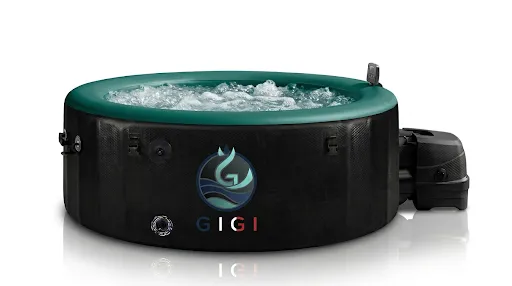
A standard soft-sided inflatable pool typically relies on an inflated ring at the top edge to hold its rough shape, with the rest of the wall made from thin, unpressurized (or lightly pressurized) vinyl. That wall has no independent rigidity: it bulges outward under the weight of the water, which is why most ring-top inflatable pools stay under 3 ft deep — beyond that, the wall simply cannot hold its shape without buckling.
A stitched-core wall behaves completely differently, because rigidity comes from the internal thread structure across the entire height of the wall, not from a single top ring. That is what allows rigid inflatable pools, iPoolgo France's included, to reach depths in the 4 ft to 5 ft range while remaining a single inflatable structure with no metal parts. The depth ceiling on a drop stitch pool is set less by "can the wall hold its shape" and more by practical factors: how much pressure the seams and connection points are rated for, and how much water weight the base panel and the ground beneath it need to support.
In practical terms, this is the difference between a pool where an adult can only wade and one where an adult can comfortably stand chest-deep or swim a few strokes — a meaningful jump in usability for the same rough footprint.
Durability compared to standard inflatables
Two factors make this high-pressure construction noticeably more durable than basic vinyl inflatables. First, the working pressure itself: at roughly 15 PSI, a drop stitch wall is far more taut and far less prone to sagging, wrinkling, or losing shape over a season than a low-pressure inflatable, which softens visibly as ambient temperature drops or as the material stretches with repeated use. Second, the distributed thread structure spreads mechanical stress across thousands of connection points instead of concentrating it at a single seam or ring, which is the failure point on most cheap inflatable pools.
That does not make a stitched-core pool indestructible — like any inflatable structure, it can still be punctured by a sharp object, and UV exposure over multiple seasons will eventually degrade any outdoor vinyl or PVC material regardless of construction method. But for the specific failure modes that plague basic inflatable pools — losing shape, bulging, and seam fatigue — the drop stitch method is a structural upgrade, not just a marketing term. This durability profile is a big part of why rigid inflatable pools, across brands including iPoolgo France, sit at a higher price point than basic ring-top inflatables: the material and assembly cost more to produce a wall that behaves this way.
Frequently asked questions
What does "drop stitch" actually mean? It refers to the manufacturing technique of weaving thousands of short connecting threads between two fabric layers, so that inflating the resulting panel locks its thickness and makes it rigid, rather than floppy like a standard inflatable.
What pressure do rigid inflatable pools use? Most rigid inflatable pools, iPoolgo France's range included, reach a working pressure of around 15 PSI once fully inflated — considerably higher than the low pressure used in a standard vinyl ring-top pool.
Is drop stitch the same technology used in paddleboards? Yes, it's the same core construction principle used in inflatable stand-up paddleboards and high-pressure inflatable boats, adapted to a vertical pool wall instead of a flat board deck.
How deep can a rigid inflatable pool go? Depths in the 4 ft to 5 ft range are common across the category. You can see this technology applied on GIGI FRANCE pools, a US-facing brand that markets stitched-core pools deep enough for adults to swim in — something a basic ring-top inflatable pool cannot offer.